
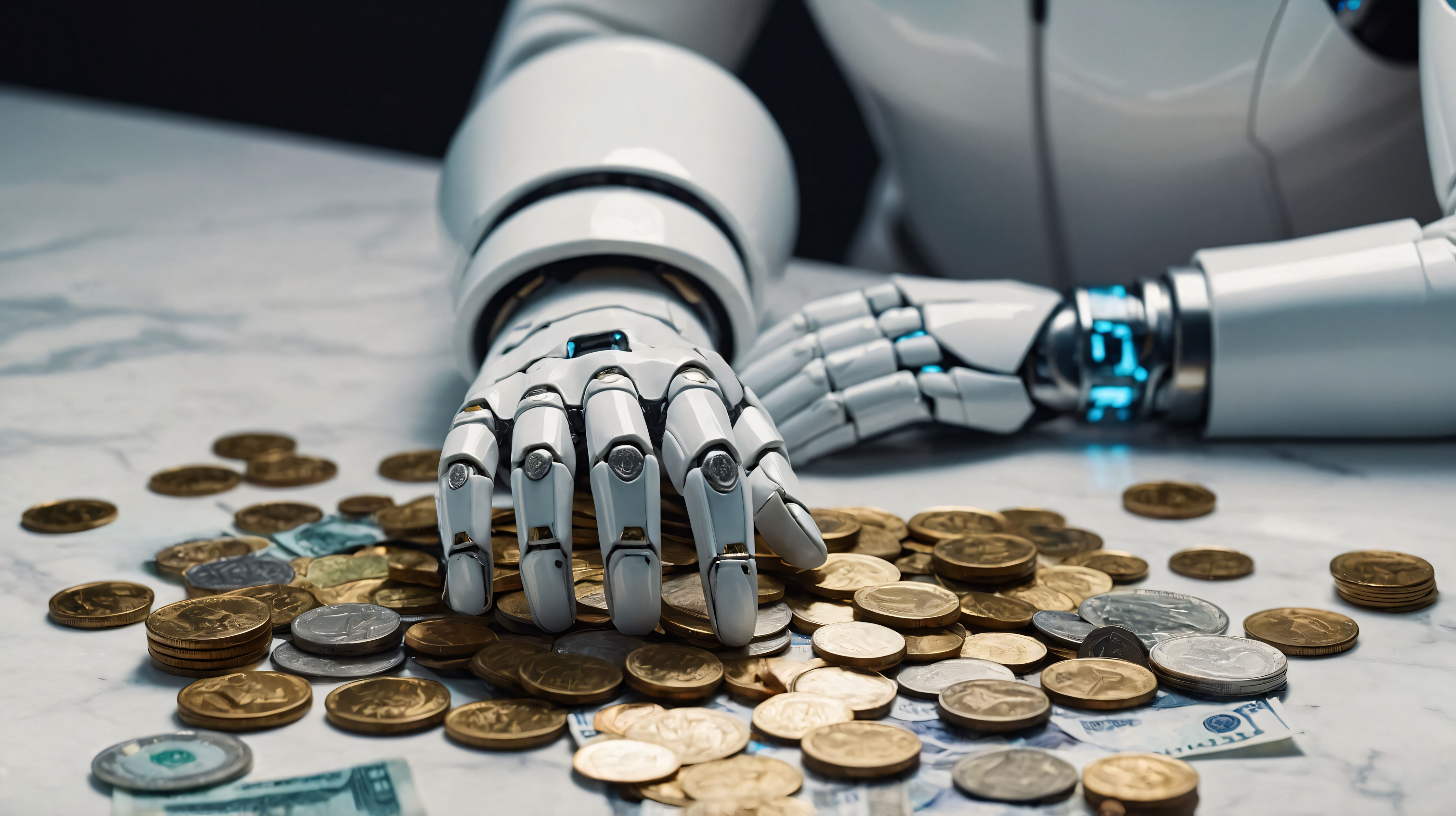
(image by freepik)
We’re living through an invisible revolution. It’s not televised. It’s not loud. But for the first time in modern history, the laws of economics are being rewritten—not by governments or billionaires, but by algorithms and self-learning machines.
Investing in 2025 doesn’t just feel different—it is different. Because AI has quietly made the cost of making things collapse, forced policymakers to reimagine labor, and created the first real opportunity for humans to consume without limits.
It isn’t just a shift in how we invest. It’s a shift in what we believe is even possible.
AI Has Erased the Ceiling on Supply
Historically, production had limits—capital, labor, land, time. Economic models were built on the assumption that scarcity drives value. But AI has broken this logic.
Today, a single large-language model can write millions of articles, analyze decades of legal documents, write code, generate films, design buildings, and even assist in drug discovery. AI is not scaling human effort—it’s decoupling value creation from human effort entirely.
This means the cost of replicating knowledge, intelligence, even creativity, is nearing zero marginal cost.
Products and services that once needed entire teams can now be delivered by a few engineers and powerful models. As AI generates everything from customer service to investment advice to therapy bots, the old need for expensive, labor-driven supply chains begins to vanish.
If the cost of making almost anything falls toward zero, what remains scarce?
Demand Becomes the New Frontier
In the 20th century, companies chased efficiency. In 2025, they chase engagement.
If anyone can produce infinite goods—videos, clothes, apps, advice—then the real value lies in capturing human attention and desire. The economy flips: supply is automatic, but human demand becomes rare and valuable.
This is where Universal Basic Income (UBI) enters the picture—not as a left-field utopia, but as an economic necessity.
As AI replaces more jobs and wages shrink in many sectors, people still need purchasing power. They still need dignity. And they are still the core engine of economic activity, because their time, attention, tastes, and preferences are now the only scarce things.
Governments across the world are starting to accept this: to keep economies running, humans must be funded to consume, not just work.
UBI becomes a platform, not a safety net.
Consumption as Identity, Not Survival
Once the basics are handled by AI—food, health diagnostics, logistics, services—humans are free to consume for identity, not survival. The digital economy begins to expand into a space that is personal, artistic, and emotional.
People begin to pay for:
- Hyper-personalized experiences
- Self-curated content and entertainment
- Status signaling in virtual and real economies
- Human connection and belonging
Investors now look not just at factories and labor productivity, but at platforms that capture evolving human desire—because that’s the new supply bottleneck.
And when every person is empowered with a basic income, consumption unlocks for the next 5 billion people—not just in Silicon Valley, but in Kanyakumari, Karachi, Kampala, and beyond.
What This Means for India: The 1.4 Billion Opportunity
India is no longer a country of the “next billion.” It is the billion. With a young, mobile-first population, growing data infrastructure, and a vast informal economy—India stands at the frontier of the AI + UBI + infinite-demand revolution.
Here’s why this matters:
- India’s labor market is massive, but vulnerable to AI automation. Traditional jobs in BPOs, retail, and even parts of IT will be disrupted. UBI can prevent economic collapse and enable transition.
- India’s youth are digitally native. With AI tools, a teenager in Jaipur can build a global business from their phone. But they need financial stability to explore that potential—something UBI can provide.
- India’s entrepreneurial energy is limitless. But in a world where AI handles production, the new focus is on creativity, curation, and connection. A nation with 1.4 billion human stories is rich in that.
- Consumption in Tier 2 and Tier 3 cities will explode once AI-driven logistics and personalization are democratized. But only if people have baseline income to participate.
The old dream of “jobs for all” is being replaced by a new dream: “dignity for all, creativity for each.”
India can lead this shift. But it must think beyond GDP and jobs—it must design systems that allow its citizens to own their time, express their culture, and engage with AI as partners, not as victims.
The Final Word: Why This is the Most Investable Moment in History
For investors, 2025 marks the beginning of capitalism without scarcity. A world where every person can become a consumer-creator. A world where production is limitless, and the bottleneck is imagination.
India—with its scale, diversity, and digital backbone—is not a laggard to be uplifted. It is the canvas on which this new economy will be painted.
Invest in companies that align with dignity. Bet on platforms that elevate human experience. Back systems that give people freedom from survival, so they can choose creation.
Because in a world where AI does the work, humans will define the worth.
Leave a Reply